
Dialogue between youth and diplomacy: meeting at the Nicaraguan Embassy with LUISS and Sapienza students
by Maddalena Celano
Introduction
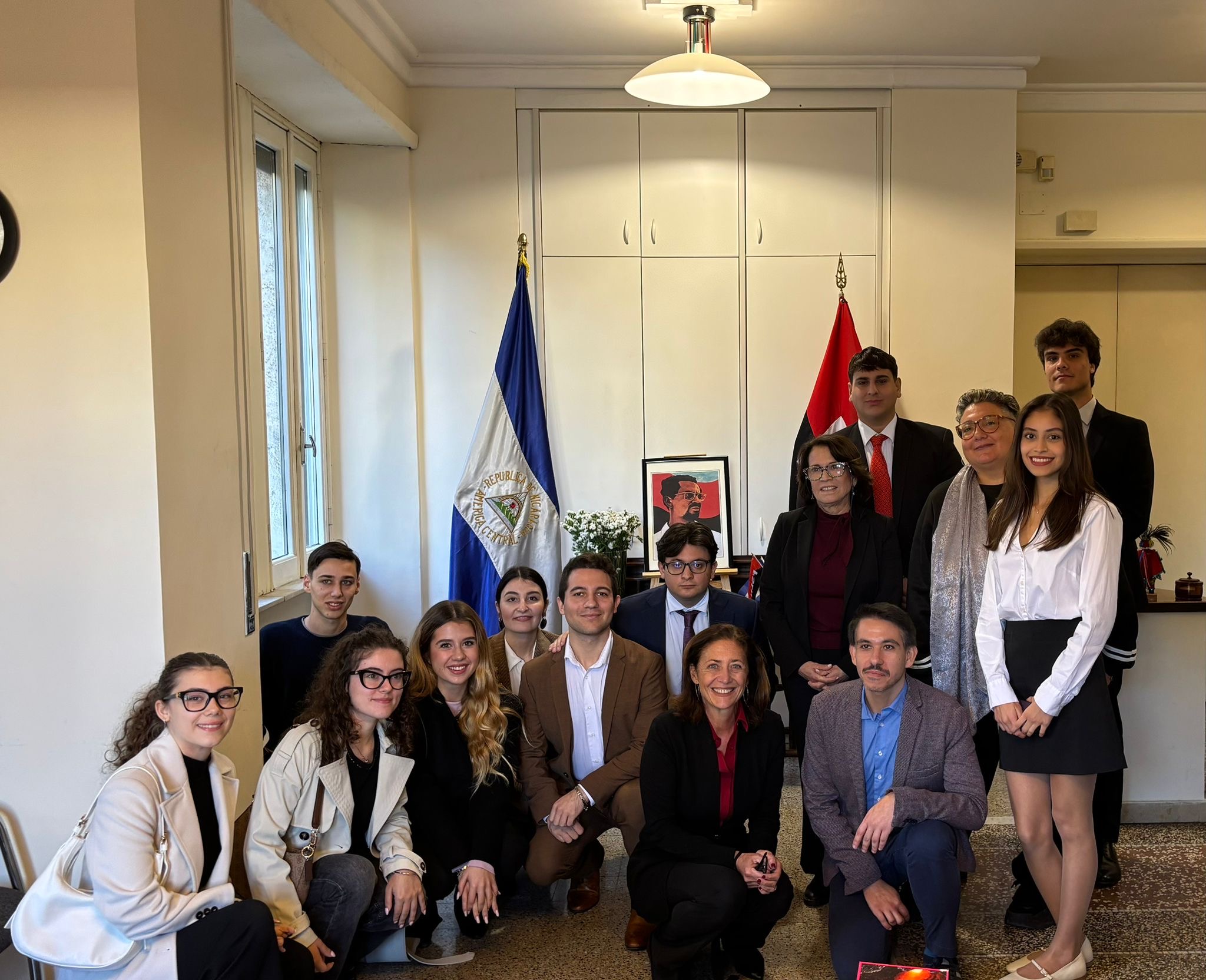
Rome, Nov. 6, 2025 – A high-profile cultural and diplomatic meeting was held at the Embassy of the Republic of Nicaragua in Italy, organized in collaboration with Welcome Association Italy, represented by Carlo Palumbo, Deputy National Secretary, and Prof. Maddalena Celano, scholar and political analyst.
The meeting was hosted with great willingness by H.E. Ambassador Mónica Robelo, who welcomed a delegation of young university students from several Roman universities.
Student participation
The initiative involved students and representatives from various associations at LUISS Guido Carli and Sapienza University of Rome, including:
- Daniela Aleman, Francesca Fernandez and Nicola Garofalo – International Networking Association (LUISS)
- Chloe Monique Quevedo and Sofia Elisa Bartolani – Ambassadors Aligned Association (LUISS)
- Gianluca Boromeo and Eleonora Santarelli – European Youth Network (LUISS)
- Giovanni Mazzaro and Niccolò Mauro – International Relations Innovation and Sustainability (Sapienza)
- Eleonora Giannetti and Elena Maggi – Students Diplomatic Association (LUISS)
Ambassador Mónica Robelo’s message.
In his speech, H.E. Robelo offered an insightful reflection on the geopolitical situation of developing countries and the role of the Global South in the international context.
He denounced the threats of war and strategies of destabilization affecting Latin America and the Middle East, dwelling in particular on the genocide in Palestine and the disinformation campaigns affecting countries such as Cuba, Venezuela and Nicaragua.
“Systematic disinformation,” the Ambassador stressed, “aims to obscure the voices of peoples defending their sovereignty and self-determination.”
Historical reflection: the lesson of Nicaragua
For the students, the meeting was also a moment of historical and civic insight.
Nicaragua represents, in the Latin American context, an example of resistance, dignity and self-determination.
The Sandinista Revolution, led by the Frente Sandinista de Liberación Nacional (FSLN), marked the struggle against the Somozista dictatorship and the initiation of a political model based on justice and equality.
Among the most emblematic figures is Carlos Fonseca Amador, founder of the FSLN, a pedagogue and intellectual who conceived the revolution as an educational and cultural process of collective liberation.
Fonseca promoted the creation of a public university accessible to all, convinced that the emancipation of peoples comes through knowledge and informed participation.
Understanding Nicaraguan history, from the wounds of the Contras to the social achievements of the Sandinista movement, means forming a critical and global view of the contemporary world.
Dialogue and future prospects
During the discussion, students posed numerous questions to the Ambassador on topics related to diplomacy, Nicaraguan history and the difficult period of the Contras.
The meeting concluded in an atmosphere of open and constructive dialogue, with a mutual commitment to strengthen collaboration between the Nicaraguan Embassy and university associations, promoting future cultural exchanges and joint initiatives.
Conclusion
The Nov. 6 meeting confirmed the importance of creating spaces for dialogue between young people and diplomacy, enhancing the role of new generations as bridges of dialogue between cultures and countries.
A concrete sign of Welcome Association Italy ‘s work in promoting cooperation, mutual knowledge and international education.