
How to make an Italian resume: practical tips
Have you studied in Italy and now wish to stay to work in the country where you graduated? Or do you simply want to gain work experience in the Bel Paese? In this article we offer you some practical tips to start your job search and create a really effective resume in Italian.
What does it take to work in Italy as a foreigner?
If you are a citizen of the European Union working in Italy will be very easy for you: all you need to do is apply for an Italian tax code.
In case, however, your home country is outside the European Union, you can only work in Italy with a valid residence permit.
If you are a student, your residence permit already qualifies you to work in Italy, as long as you meet the limit of 20 hours of work per week.
To work full-time, however, you will need to apply for conversion of your study permit to a work permit (if you have already received a job offer) or “attesa occupazione” (if you are looking for work). The request for conversion can also be made before you finish your studies.
If you are looking for help in carrying out this paperwork, you can request assistance from Welcome Association Italy and make it quick and easy.
How to make a resume in Italian
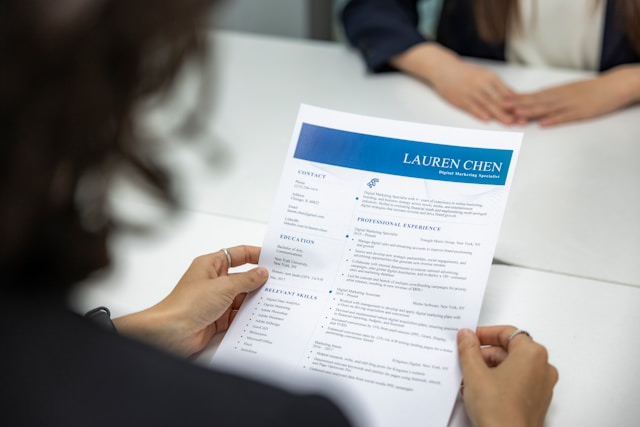
The resume is your ticket to getting a job interview. That is why it should be written with care and attention, always keeping in mind what the employer is looking for.
A good strategy is to have multiple versions of the resume, or to adapt it from time to time according to the specific application. Also remember to always attach a cover letter or motivation.
Some general tips:
- uses short but complete sentences with all relevant information;
- check for grammatical spelling errors (if Italian is not your native language, get help from a friend or professional);
- use keywords to attract the employer’s interest (analyze the ad well to understand exactly what they are looking for).
Curriculum vitae europass italian
Until not so long ago, the curriculum vitae that was used in Italy for any kind of profession was the Europass format. Although some web platforms still suggest it, today the Europass format is considered outdated: it is too long, inflexible and visually unattractive. Today, slimmer (maximum two-page) and visually more curated templates are preferred, such as those offered by Canva, for example.
Especially if you are looking for a creative job, having to do with design or marketing, we would advise against using the Europass format for your Italian resume.
Italian curriculum example
What should your Italian resume contain? All the information that is useful for the company or employer to understand who you are and why you are a good candidate. Here are the sections that cannot be missing from your Italian resume (in order of importance):
Biographical data
The essential biographical details to be included in the Italian resume are: first name, last name, residential address, contact information (phone number and/or email address). Other details are optional, such as date of birth (often omitted to avoid age discrimination) and personal photo. In Italy, it is not mandatory to add a photo to your resume, but it remains a fairly common practice: it is up to you to decide whether or not to include it.
Training experience
List your studies in descending chronological order, for example: master’s degree, bachelor’s degree, high school diploma. You can also enter any extracurricular training courses you feel are relevant in this section.
Work experience
Always post your work experiences starting from the most recent to the least recent. Focus only on positions that are really relevant to your career. Do not cite all the jobs you have had, but only those that helped you acquire skills useful to the type of profession you are seeking. Don’t forget to mention your start and end dates of employment and to describe the job title you held in detail.
Foreign languages
List the foreign languages you know by placing the corresponding Common European Framework of Reference for Languages (CEFR) level (A1-C2) on the side.
Specific skills and abilities
If the position requires technical skills, such as software, digital tools or programming languages, enter them here.
Alternatively, you can use this section to talk about your soft skills: organizational skills, communication skills, aptitude for teamwork, problem solving, and so on.
Hobbies and passions
Use this section of the resume to make sure that human resources personnel can get to know you better and get a fuller picture of your personality. Talk about any sports, activities that you are passionate about and that you think will transfer important skills to your career.
Authorization to use personal data
By Italian law before handing in your CV vitae, you must include an authorization to process your personal data and sign the resume. Only with this authorization is the human resources staff authorized to use your email or telephone contact information to contact you for a possible job interview.
Here is an example of wording you can include at the end of your CV:
“I authorize the processing of my personal data in accordance with Legislative Decree No. 196 of June 30, 2003 and the GDPR (EU Regulation 2016/679).”